Wednesday, December 1, 2010

Getting Ready for the Holidays... It's Another Giveaway!

What, you thought that since National Blog Posting Month was over I'd stop posting? Well, I thought about it, but decided that this was more important. :) I've teamed up with CSN stores again for another giveaway! (Go check out some of their 200+ stores selling things from leather messenger bags, to cookware, to furniture.)

The holidays are upon us which means shopping, shopping, and more shopping. Me? I'm a fan of the "shop from your computer" style. I hate fighting crowds and refuse to get up well before the crack of dawn to stand in line in the cold for a gift. Now don't get me wrong. I love giving gifts. I think it's fun to try and find just the right thing for a person -- I hate buying straight off a list.

All this buying means one thing -- a stressed out wallet. Let me help you alleviate that problem by giving you the chance to win a
$45 CSN Giftcard
which is good to use in any of their stores. You can use this to buy a loved one something off their wishlist, or save it and get yourself that one thing no one bought for you.

This one's going to be a quickie (to make sure you have time to get your items!) so hurry and comment! CSN is having a ton of sales, daily deals, and free shipping on many items! Look for this guy:
to make sure your gift will arrive in time!

The Rules:
We're going to switch it up this time to make sure you get lots of opportunities to win!
  • Giveaway opens Wednesday, December 1, 2010 and closes on Friday, December 3, 2010 at midnight PST.
  • Make sure you leave your email or a way to contact you in the event you win. The winner will have 24 hours to respond, and if not, another winner will then be selected.
  • You can leave a comment once per day, so up to 3 times. You can tell me what is on your "most wanted" list, your favorite part of the holidays, or even just "hi!" or "pick me!".
  • You can tweet about the giveaway once per day, then post a link back to that tweet below. (Simply click on the "XX minutes ago" link underneath your tweet, and a permalink for that tweet will come up. It should look like: www.twitter.com/#!/yourusername/status/0120103821309.)
  • You can mention the giveaway on your own blog once per day, and then post a link to that entry below (must be specific page, not just your homepage).

That's a total of 9 chances to win!

The winner will be chosen by a holiday-spirit lacking random generator sometime Saturday morning (sometime before noon EST) and then posted once the winner responds.

Good luck and happy shopping!

Tuesday, November 30, 2010

Spicy Popcorn


About a week ago, our microwave stopped working. Randomly, in the middle of trying to reheat some leftovers for lunch. Frustrating? Yes. Especially when I have some amazing leftover Drunken Noodles hanging out in the fridge just begging to be eaten. Alas, it needs a new part which will be here at the earliest on Friday. Grr.

Having a broken microwave also guarantees one other thing -- no popcorn. Well, at least none of the bag popcorn. And of course, that's when I start to get the popcorn craving. Now, I come by these popcorn cravings honestly -- when I was younger it seemed that my mom was always popping up a bag of popcorn to munch on. Although I have to admit, plain ol' popcorn with no salt or butter doesn't really do it for me. Yeah, I was always that kid that smothered their popcorn with butter at the movie theater.

So what to do with no microwave to help satisfy my craving? Make it old school style. This way we can change the flavor to our liking AND get rid of that partially hydrogenated oil (read: trans fat) that hides out in those bags. I opted for some buttery popcorn with a little bit of a kick to it.


Spicy Popcorn
From: Original Recipe

1/2 cup olive oil
1 cup popcorn kernels
5 tablespoons butter
1/2 cup Parmesan cheese, grated
1/2 teaspoon cayenne pepper
1 teaspoon garlic salt

Heat the oil in a large stockpot over medium-high heat. Once oil is hot, add the popcorn kernels, cover, and shake to form an even layer. Cook for about 3 minutes, then shake pot again. Once kernels start popping shake every few seconds. Remove from heat once popping subsides. Transfer popcorn to a large serving bowl.

Meanwhile, in a small saucepan over medium-low heat, melt butter. (You can also melt the butter in the microwave in a microwave-safe bowl.)

Pour half of the melted butter over the popcorn. Sprinkle half the cayenne pepper, garlic salt, and cheese over popcorn and toss. Add the remaining ingredients and toss again.

Makes: 10 2-cup servings


Making my own stove-top popcorn was much, much easier than I had anticipated. While trying to figure out my ingredients, I skimmed across a recipe that claimed 1 cup of popcorn kernels made 20 cups. I laughed. Yeah right. Then I made popcorn from 1 cup of kernels. Yeah, not really a joke. It really does make that much. (I had to use a my super huge pyrex bowl and the next largest one just to fit it all.) I highly recommend using a very large pot to make this in -- I used my 8 quart stockpot and it worked perfectly.

Even at room temperature, this popcorn makes for the perfect munching snack. As evidenced by the fact that I have almost taken down the smaller of the two bowls of popcorn. And I may have just made it this morning...


Nutrition Facts
Amount per serving
Calories 231Calories from fat 169
% Daily Value
Total Fat 18.7g29%
Saturated Fat 6.1g31%
Cholesterol 20mg7%
Sodium 119mg5%
Total Carbs 12.9g4%
Dietary Fiber 2.4g9%
Protein 4.1g
Vitamin A 5%Vitamin C 0%
Calcium 6%Iron 4%

Get Up and Move Challenge Day 30: The End

Sometimes I feel like these past 30 days have just flown by. Other days I can't believe National Blog Posting Month is still going on. Well, it is officially coming to a close today, and with it, our Get Up and Move Challenge. Let's take a look back at all we've talked about this month:


If you successfully completed the Get Up and Move Challenge by performing some type of exercise each day, then pat yourself on the back. Congratulations!


Feel free to take this image and post it to your blog or facebook page. Be proud of your accomplishment!

Now that our challenge is over, keep up your hard work! Below are the American College of Sports Medicine's recommendations for weekly exercise [1]:

Aerobic Exercise:
  • At least 5 days per week at a moderate intensity, or at least 3 days per week of vigorous activity
  • At least 30 minutes per day for health benefits and 60 or more minutes per day for weight loss or weight maintenance.

Resistance Exercise:
  • 2-3 days per week, with at least 48 hours separating the training sessions for the same muscle group
  • 8-10 various exercises focused on the major muscle groups
  • A resistance that allows 8-12 repetitions per set should be selected

Flexibility:
  • 2-3 days per week
  • 4 or more repetitions of each stretch, with each static stretch being held 15-60 seconds

If you have a known pulmonary, metabolic, or cardiovascular disease (or signs and symptoms of one) talk with your physician before starting an exercise program.

Keep in mind that these guidelines are for healthy adults 18-65. If you find yourself outside this range or have other ailments, talk to your physician or a trained exercise professional for guidance on where to begin. Remember, you don't have to try and run a marathon on your first day, instead, gradually build up to the recommended levels. Then enjoy the fact that you are becoming healthier with each passing day!

[1] American College of Sports Medicine. Resource Manual for Guidelines for Exercise Testing and Prescription. Philadelphia, PA: Lippincott Williams and Wilkins, 2010.


Monday, November 29, 2010

Korean-Style Pork Tenderloin


Raise your hand if you've seen enough turkey to last you for a very long, long while. Or mashed potatoes. Or green bean casserole. Mine's raised. Don't worry, I will have a recipe or two for you that will work excellent for any upcoming holiday feasts, but let's take a break from all that heavy goodness.

Instead, let's switch it up a bit. Let's have some pork with an Asian flair that involves barely any work to throw together. I'm game.

Korean Pork Tenderloin
Adapted from: Cooking Light, September 2002

1/3 cup soy sauce
2 tablespoons sugar
1 teaspoon ground ginger
3 tablespoons rice vinegar
1 tablespoon sesame oil
1/4 teaspoon crushed red pepper
4 garlic cloves, minced
1 pound pork tenderloin, trimmed
Cooking spray

In a large ziploc bag, combine first 7 ingredients (through garlic). Add pork, seal, and roll tenderloin to coat. Marinate in refrigerator 8 hours or overnight, turning occasionally.

Preheat oven to 425 degrees F. Line a deep baking pan with foil.

Heat a large skillet coated with cooking spray over medium-high heat. Remove pork from bag. Reserve marinade. Brown pork in pan, about 1 minute per side.

Transfer pork to baking dish. Bake at 425 degrees for 20 minutes, or until 160 degrees. Let stand 5 minutes before slicing.

Meanwhile, in a small saucepan, bring reserved marinade to a boil. Reduce heat, and simmer 5 minutes.

Cut pork into 1/4-inch-thick slices; serve with sauce.

Serves: 4


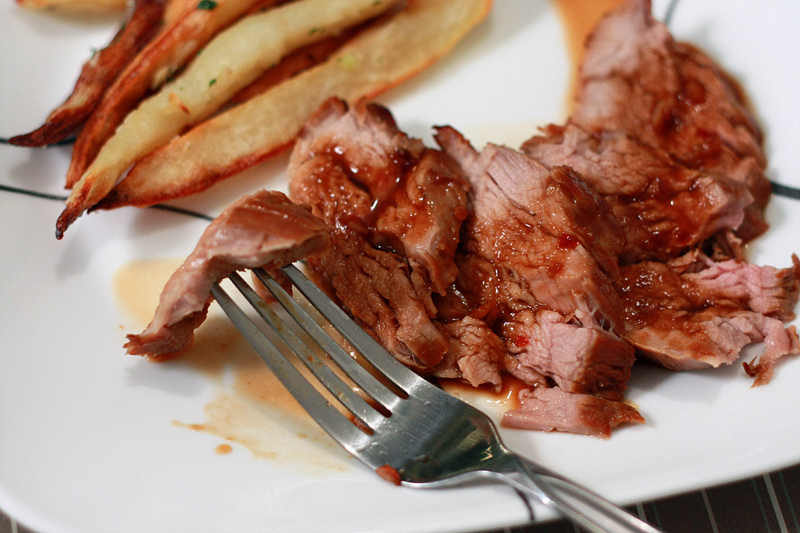
This pork was excellent and a perfect change from the fall flavors and heavy casserole type dishes we've been eating as of late. It was sweet and savory and paired well with the garlic fries. Don't skimp out on cooking the marinade -- it really gives the pork a big punch of flavor. As long as you remember to prepare this in advance (which I had a tendency to keep forgetting), it's great for a quick, low-stress meal.


Nutrition Facts
Amount per serving
Calories 243Calories from fat 68
% Daily Value
Total Fat 7.6g12%
Saturated Fat 1.9g9%
Trans Fat 0.0g
Cholesterol 83mg28%
Sodium 1263mg53%
Total Carbs 9.3g3%
Sugars 6.7g
Protein 31.2g
Vitamin A 1%Vitamin C 2%
Calcium 2%Iron 10%

Get Up and Move Challenge Day 29: Is exercising while pregnant safe?

Only one more day left in the Get Up and Move Challenge! I really can't believe we've made it this far!

Today we're going to look at the safety of exercising while pregnant, as many women are unsure if it's safe at all, let alone what level they should be exercising at.

Not only is exercise safe to perform while pregnant, it can help to improve the health of the pregnancy as well. Obviously, a women's body goes through many changes while pregnant. Increases in the levels of estrogen, progesterone, human chorionic gonadotropin (HCG), relaxin, prolactin, and oxytocin all help to transform the female body into a nice safe place for the baby to grow.

Weight gain during pregnancy is expected and necessary, however, there is a point where it can become excessive. The current weight gain goal for females is between 25-35 pounds. Now, not all of this weight is caused from a simple gain in fat tissue. In fact, only about 7 of those pounds is extra protein, fat and nutrients stored by the mother. The other weight comes from (at full term):
  • 7.5 pounds from the baby
  • 4 pounds from extra blood
  • 4 pounds of additional body fluids
  • 2 pounds of increased breast tissue
  • 2 pounds of increased uterus weight
  • 2 pounds of amniotic fluid
  • 1 1/2 pounds from the placenta
This extra 7 pounds of fat weight should come from an additional 300 calories consumed per day [1]. Yup, 300 extra calories per day, that's all that's needed.

If you find yourself eating healthy and not to excess, yet still gaining lots of weight, don't worry. Your body is designed to increase your fat stores during the first two trimesters.

In the past, worries arose regarding exercising while pregnant for two main reasons: 1) the increased blood flow during exercise would be diverted away from the fetus causing a decrease in the nutrients and other essential items during this time period; 2) the mother's core temperature would rise, causing an increase in fetal temperature and affecting the narrow pH of the blood. Good news! As long as exercise is within reason (not a marathon), and the mother stays adequately hydrated, the baby will be just fine.

In fact, low to moderate-intensity exercise is actually encouraged during pregnancy. Exercising promotes a healthy weight gain, reduced occurrence of gestational diabetes, adequate blood pressure, a decreased risk of preeclampsia, improved circulation (reduces or prevents swelling), as well as an easier pregnancy and labor and delivery.

How do I need to modify my exercise while pregnant?
First off, there are certain contraindications for exercising while pregnant, some of which include: significant heart disease, restrictive lung disease, incompetent cervix (which you would most likely be on bed rest anyways), pregnant with multiples, persistent bleeding, placenta previa after 26 weeks, a previous premature pregnancy, ruptured membranes, and preeclampisa or pregnancy induced hypertension.

For those healthy females with a healthy pregnancy, prior to starting a training program, talk with your OB and get their clearance.

While pregnant, you are able to continue with most activities, just at a lower intensity. You are still aiming for at least 3 days per week, building to at least 30 minutes per day. You should be working out at a low to moderate-intensity. The recommended heart rate ranges are broken down by age as follows:
  • less than 20: 140-155 bpm
  • 20-29: 135-150
  • 30-39: 130-145
  • greater than 40: 125-140

Activities such as soccer, basketball, contact sports, those with a high risk of falling (skiing, horseback riding, rock climbing), or activites that cause jarring or sharp changes of directions should be avoided. However, things such as cycling, walking, jogging, swimming, and even resistance training are all still on the table. Other things to avoid involve supine positions (on your back) after the first trimester, motionless standing, vigorous activity in the first trimester, the valsalva manuever, and exercising within 6 weeks post-delivery (your doctor will need to clear you to start exercising again).

During exercise, make sure to extend your warm-up and cool-down periods to at least 5-10 minutes. Also, make sure to stay hydrated! It is recommended to take in 8 ounces every 30 minutes (having a bathroom nearby is also handy). Try focusing on strengthening your abs, back, pelvic floor, and other muscles involved in labor (such as your inner thighs).

Just because you are pregnant doesn't mean you have to give up exercising. You can still perform many of your favorite workouts, just at a lower intensity. Remember, if you aren't feeling well, you don't have to push yourself to work out. Your goal should not be to train for an upcoming race while pregnant, but instead simply to have a healthy and easier pregnancy. Over-exercising can have detrimental effect to the fetus, so make sure to stay within your appropriate heart rate range and a reasonable duration.

[1] American College of Sports Medicine. Resource Manual for Guidelines for Exercise Testing and Prescription. Philadelphia, PA: Lippincott Williams and Wilkins, 2010.

Sunday, November 28, 2010

Get Up and Move Challenge Day 28

Get Up and Move Challenge Day 28: Is being flexible important?

In the realm of exercise, aerobic and resistance training usually take center stage. As they should, being that they provide the main health benefits of exercise. Flexibility often gets tossed out the window and forgotten with most people, however, as we age, working on our flexibility becomes more and more important.

Stretching exercises can help to improve a joint's range of motion as well as physical function [1]. Right now you may think this doesn't matter. Right now you may be able to reach up over your head and pull down a set of heavy mixing bowls, or bend over to place items in the dishwasher. The older we get unfortunately, the harder and harder these seemingly simple tasks become to do.

Not only do these tasks get harder, but the risk of falling (with the possibility of fracturing a hip) increases as well. Over 81% of deaths from falls are in the 65 and older population, and those 75 and older who fall have a 4-5 time higher risk of ending up in a long term care facility for a year or longer [2]. On top of that, those who sustain a hip fracture during a fall have a 20-25% increased risk of death. So, maybe flexibility and balance are more important than we first thought.

What type of stretching should I do? [1]

Stretching can be performed either after your warm-up or prior to a cool-down in your workout, whichever way you prefer. There are four main types of stretching:
  • Static
  • Dynamic
  • Ballistic
  • Proprioceptive neuromuscular facilitation technique (PNF)

Static stretching involves a passive relaxation of the muscle while it is elongated (such as reaching to touch your toes and holding the position). It is recommended to hold each type of this stretch for 15-60 seconds.

Dynamic stretching is commonly used prior to training or maximal events. This method involves a smooth swinging or continual motion of the muscle, stretching a little farther with each motion (stretch is not held).

Ballistic stretching involves a bouncing or bobbing movement and is not commonly recommended.

PNF technique involves passively stretching a muscle, then contracting the muscle in that position for about 6 seconds, relaxed, then moved farther into the stretch and held for about 10-30 seconds. It is not recommended that those unfamiliar with this technique and without supervision use this method.

It is important to note that regardless of the type of stretching you perform, they should be within the limits of discomfort in your range of motion, but no further.

How often do I need to perform a stretching workout? [3]
A stretching workout should be performed for at least 10 minutes, 2-3 days per week. These sessions should involve the major muscle tendons with four or more repetitions.

Workouts such as yoga and tai chi are also great programs to enhance flexibility and balance.

[1] American College of Sports Medicine. Resource Manual for Guidelines for Exercise Testing and Prescription. Philadelphia, PA: Lippincott Williams and Wilkins, 2010.

[2] Centers for Disease Control and Prevention. Falls Among Older Adults: An Overview [Internet]. [cited Nov 28, 2010]. Available from: http://www.cdc.gov/homeandrecreationalsafety/falls/adultfalls.html

[3] American College of Sports Medicine. Guidelines for Exercise Testing and Prescription. Philadelphia, PA: Lippincott Williams and Wilkins, 2010.

Saturday, November 27, 2010

Get Up and Move Challenge Day 27

Get Up and Move Challenge Day 27: Health Spotlight On Type II Diabetes. Can exercising help treat or prevent it?

Yes, yes, most definitely yes.

I am sure most of us have heard the term "diabetes" or "Type II diabetes" and know it's associated with our blood sugar and insulin, but we may not be quite sure what it is exactly. 90-95% of all diabetes mellitus cases are Type II, which results from the muscle cells becoming resistant to insulin and the body's inability to compensate for this resistance (insulin helps the body's cells take in sugar for food). What's the big deal with having a high level of blood sugar (blood glucose)? Type II diabetes is a significant cause of early death and sickness related to cardiovascular disease, blindness, kidney disease, nerve disease, and amputation [1]. So, it is a big deal, and definitely not something to take lightly.

Genetic and environmental factors play a huge role in the development of diabetes, and it has yet to be teased out with a fine-tooth comb how much each contributes. However, we do know that the risk for diabetes increases with age, obesity, and physical inactivity. While we might not be able to control our genetics or our age, we can most definitely control our weight and physical activity level.

Does weight loss and physical activity really matter when there's medication I can take? Absolutely. The Diabetes Prevention Program (DPP) investigated the difference in reduction of the incidence of Type II diabetes between lifestyle intervention (diet and exercise) versus medication (metformin) versus a control group. And guess which one came out on top? That's right, the lifestyle intervention. In fact, the lifestyle intervention group actually reduced the risk by a whopping 58% as compared to only 31% by the medication group [2]. That's a whole 27%!

How does that even happen? Quick science lesson:
During rest and after eating, the muscle cells are dependent on insulin to be able to take in glucose from the blood. They need this glucose to replace their glycogen stores in order to keep functioning. During exercise, the muscle contractions allow the muscle cells to increase their uptake of blood glucose without the help of insulin. These two pathways are separate, thus even when the insulin-needy pathway is impaired by diabetes, the blood glucose uptake still functions normally during exercise.

Exercising can have both immediate and long term effects on a person's blood glucose levels. One bout of moderate-intensity exercise can cause an increase in insulin action and glucose tolerance for 2-72 hours afterwards (varies by the duration and intensity of the exercise). Over time, exercise training can improve insulin action, blood glucose control, and fat oxidation and storage in muscle (which is better than in fat cells). However, any exercise program must be performed regularly to have a continued effect.

So now that we know physical activity is excellent at helping to prevent and treat diabetes, what kind of exercise do we need to be doing [1]?
  • Moderate-intensity aerobic (such as brisk walking) and resistance training (such as weight lifting)
    • Either alone will work, but performing both gives the best results
    • Milder forms of exercise, such as tai chi and yoga, have shown mixed results, and up to this point should not substitute aerobic or resistance training
    • Aerobic Exercise
      • At least 150 minutes of moderate to vigorous activity spread out over at least 3 days per week
        • Bouts can be no shorter than 10 minutes
        • No more than 2 days should elapse between workouts
        • If relying on exercise alone for weight loss purposes, up to 60 minutes per day may be necessary
      • All aerobic exercise should be at moderate intensity (40-60% of your max heart rate), although progressing to vigorous activity can help to obtain additional blood glucose benefits
      • Any form of aerobic exercise is fair game (including brisk walking), as long as it causes a sustained increase in heart rate
    • Resistance Training
      • At least two times per week, optimally 3 on nonconsecutive days
      • All resistance training should be at moderate (50% of your 1-repetition max) or vigorous (75-80% of 1-repetition max) intensity
      • Training should minimally include 5-10 exercises involving the major muscle groups (in the upper body, lower body, and core)
        • In the beginning these sets (as low as 1) should consist of 10-15 repetitions to near fatigue in each set
        • As progression occurs, the weight should be increased until only 8-10 repetitions can be performed per set (as many as 3-4 sets)
      • Resistance machines and free weights are the recommended modes for resistance training
  • It is also strongly recommended that the training be supervised (by a trainer or other health professional) for the best results

Now there are also some warnings that need to be addressed, especially for people with advanced diseases, with uncontrolled blood glucose, or those already dependent on insulin. For those with advanced diseases and uncontrolled blood glucose levels, you can still exercise and reap the benefits. However, first have a chat with your physician to see if additional testing needs to be done and if you have any exercise restrictions. For those diabetics already taking insulin, it is imperative that you monitor your blood glucose levels before, after, and possibly during (if just starting) exercise. Depending on which insulin you are taking, it could be necessary to ingest carbohydrates prior to exercise to prevent hypoglycemia. Once again, this is a time to talk with your physician to see how much you need to take and when.

If you find yourself faced with the diagnosis of pre-diabetes or diabetes, talk to your doctor about what you can do to make lifestyle changes to help lower your blood glucose levels.

[1] American College of Sports Medicine and American Diabetes Association Joint Position Statement: Exercise and Type 2 Diabetes. Med Sci Sport Exer. 2010;42(12):2282-2303.

[2] Knowler WC, Barrett-Connor E, Fowler Se, et al. Reduction in the incidence of type 2 diabetes with lifestyle intervention or metformin. N Engl J Med. 2002;346(6):393-403.

Friday, November 26, 2010

Get Up and Move Challenge Day 26

Get Up and Move Challenge Day 26: What Motivates You?

There are only 5 days left in our Get Up and Move Challenge! Can you believe it? Seems like this month has just flown by!

Now that we've been through 25 days of exercising and trying to eat better, it's time to share our motivational tips with each other.

So what are things that help you get out of the house or off the couch and moving? What are things that motivate you while you exercise?

There are the big "heavy-hitter" type reasons, such as trying to lower your cholesterol or blood pressure, or for weight loss, but those don't have to be the only reasons. It really can be as simple as wanting to try a new type of exercise (like Zumba).

There are all kinds of ways to motivate yourself while exercising -- to help you keep going to reach that goal, rather than giving up after 5 minutes. Things such as listening to music, watching TV, or better yet, working out with a friend, can all help to keep exercise from being monotonous and boring. Varying your exercise day to day can also help keep things fresh and fun.

Thursday, November 25, 2010

Happy Thanksgiving!

Happy Thanksgiving!


I hope everyone is having a wonderful and fun-filled Thanksgiving!


What are you thankful for?

Get Up and Move Challenge Day 25: Exercising Safety

With all this talk about turkey, I'm sure the last thing on your mind is getting out and exercising today. Don't forget though, if you're taking part in the Get Up and Move Challenge, today counts too!

One of the things that's not talked much about happens to be one of the more important -- exercising safely. I'm not referring to stopping if you have chest pain or other medically related issues (although that is important as well). I'm referring to exercising safely outside.

There are three huge safety pet peeves I see often with people exercising in the great outdoors. More specifically, around busy streets and neighborhoods.

(1) Wearing an MP3 player with headphones. While not in and of itself a bad idea, many people tend to crank the volume up really loud. This can be a problem in high traffic areas, either vehicular or pedestrian. If you are walking or running down the side of a street, you need to be able to hear if there is a car or other automobile approaching. Same thing in pedestrian traffic. Many times runners or bikers will use "passing on the left" or "passing right" when they are about to go around you. If you are unable to hear this, you can easily step in their path and cause injuries to both parties. Even if they don't call out before passing, once again you still want to be able to hear if someone is around you. This doesn't mean you can't wear headphones while out and about, just keep the volume turned down.

(2) Exercising late in the day, in dark clothing without reflective gear. How many times have you been driving home from work in the winter months and had to do a double take because you didn't see a pedestrian out walking? If you are going to be out during very early hours, or dusk and later, make sure you wear at least one item of light colored clothing and more importantly, some piece of equipment or clothing that has reflective tape on it. Many drivers are busy focusing on the road (or worse, texting or talking on their phone) and are not looking for pedestrians. Make it easy for them to see you.

(3) Walking/Running on the wrong side of the road. This happens a lot, and more often than not it's because people don't know which side is the correct one. If sidewalks are available, this isn't a big concern. However, when there are no sidewalks present, it is very important you walk/run on the correct side of the street. Which side that? You always want to walk/run facing traffic. This typically means (in the US) the left side of the street. Going against traffic allows you to be aware of oncoming traffic, and to get out the way if there is a distracted driver. You can't see how close to you the approaching car is if it's coming up behind you, and this can be very dangerous.

What are some safety concerns you've seen while outside?

LinkWithin

Related Posts with Thumbnails
 
Pin It button on image hover